
An Average IT Services Deal Has 10+ Stakeholders. Most Sales Teams Speak to One.
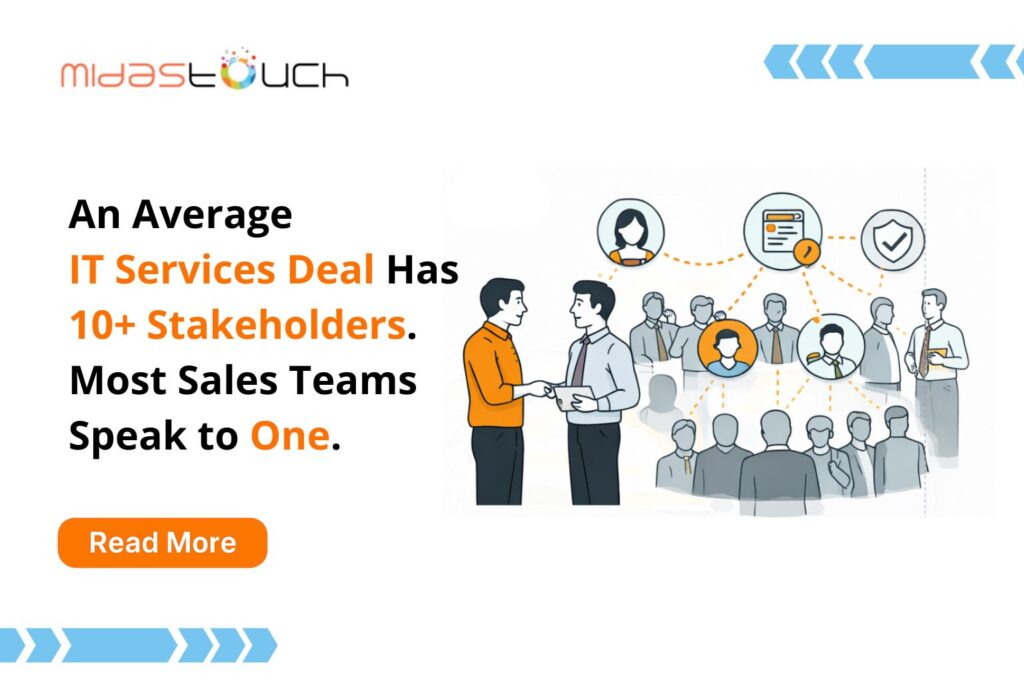
“The problem with communication is the illusion that it has been accomplished.” – George Bernard Shaw This quote has never been more relevant than in the context of B2B IT services sales. You communicate with your key contact. Your contact nods. The proposal goes in. And then, silence. Sound familiar? The Reality of B2B Buying Has Changed Let me share something we see consistently while working with IT services companies across India. The sales team builds a solid relationship with one person — typically a Tech Manager or Head of IT. The meetings go well. There is genuine interest. The proposal is strong. And yet, the deal stalls or goes to a competitor. Here’s why. According to Forrester, the average B2B technology purchase today involves 13 people across the organisation. And 89% of purchases involve stakeholders from two or more departments. That means the deal is rarely decided by the one person your sales team is speaking to. While your team is having a great conversation with that one person, there are twelve other people forming an opinion about your company, and scarily, most of them have never heard from you. Who Are These 13 People? Think about a typical IT services deal at a mid-size company. Your primary contact is the Head of Technology. But here’s who else has a say: Your salesperson has a great relationship with one of these people. The rest? They either found your website on their own, looked up your LinkedIn, or formed their opinion based on what your contact told them in a meeting you were not part of. That is a significant gap. And it is one most IT companies are not addressing. The Role of Your Contact Your contact is someone who agreed to take your call. A champion is someone who actively sells for you when you are not in the room. Most IT companies treat their primary contact as their champion. But that person’s internal influence varies widely. Their willingness to push a new vendor through an approval process depends on how much they trust you, how well you have equipped them, and how much internal credibility they have. So, the last time your salesperson left a meeting with a positive outcome, did that person walk out with everything they needed to make the case for you internally? Did they have something concrete to share with the CFO? A relevant answer for the procurement team? A way to handle the skeptic’s objections? Or did they just have a warm feeling about the conversation? The Stakeholder Your Sales Team Consistently Overlooks In my experience of working with B2B technology companies, there is one stakeholder that almost always gets ignored in the sales process: the internal skeptic. This is the person in the buying group whose job (formal or informal) is to slow things down and ask the difficult questions. They have seen IT projects go over budget. They have sat in the post-mortem meeting after an implementation that did not deliver. They are not being difficult. They are being careful. And here’s the thing — if your company has a thin digital presence, no published case studies, and a dormant LinkedIn profile for its leadership, the skeptic has ammunition. They can simply say, “I couldn’t find much information about this vendor online. Let’s keep evaluating.” You will not even know that conversation happened. What Does Multi-Stakeholder Selling Actually Require? Here is what we have seen work for IT companies that consistently win complex deals: 1. Visibility before the conversation starts. If seven of those thirteen people encounter your company for the first time when your proposal arrives in their inbox, you are at a disadvantage. The companies that win are the ones that several stakeholders have already come across, either through thought leadership content, their founder’s LinkedIn presence, or peer recommendations. 2. Content built for different stakeholders. The IT Head cares about technical fit. The CFO cares about ROI and risk. The business unit leader cares about implementation disruption. One proposal document cannot speak effectively to all of them. Supporting materials such as relevant case studies, ROI frameworks, risk mitigation narratives must reach the right person at the right stage. 3. Equipping your contact to succeed internally. When a meeting ends, the question is not “did that go well?” The real question is: “Does this person now have everything they need to represent us in rooms we will never be invited into?” If the answer is no, the meeting was incomplete. 4. A market presence that works even when your sales team is not. At some point, someone in that buying group will search for your company. What they find in those 10 minutes of online research will shape their opinion significantly. A strong website, a founder who posts insightfully on LinkedIn, and published case studies speak for you when your sales team is not present. The Connection Between Market Presence and Multi-Stakeholder Deals This is the part that most IT companies miss. Multi-stakeholder selling is not just a sales challenge. It is a marketing challenge. Although you cannot send your sales team into every room where your company is being discussed, the good news is that your content can travel there. Your founder’s LinkedIn post can be shared in an internal Slack channel by someone who found it useful. Your case study can be forwarded by your contact to the CFO before a review meeting. Your website can answer the procurement team’s vendor evaluation questions at 10 pm on a Sunday. The companies that win large, complex IT deals are not always the ones with the best solution. They are often the ones that multiple stakeholders had already heard of, trusted, and felt confident recommending internally. Building Credibility – One Step at a Time Whether you are telling it or not, the story of your IT company is being told – in buying group meetings, in internal emails, in online searches. The question you need to answer is whether the version being told is the one you want. If