


India’s Global Capability Center (GCC) ecosystem is booming. Over 1,500 GCCs have already been established, with more entering the market every month. Beyond cost benefits, global enterprises are betting big on India for deep tech expertise and strategic innovation.
This presents a significant opportunity for Indian IT services and product engineering companies.
However, despite having the skills and delivery experience, many tech firms aren’t even making it to the conversation table.
Why?
Because they don’t exist in the digital world.
GCCs Are Looking. Are You Being Found?
The average GCC decision-maker is not going to discover your company through cold calls or cold emails. They start online. They first build the shortlist based on LinkedIn presence, leadership updates, blogs, case studies, and web presence.
This is how risk-averse enterprise buyers validate potential partners.
So when your company isn’t discoverable or doesn’t show up meaningfully, you’re invisible.
The Visibility Gap Hurting Tech Firms
Let’s say you’re a 200-person tech firm with strong capabilities in cloud, DevOps, or automation. You’ve worked with a few international clients, your delivery is solid, and you have a lean in-house marketing team. From the inside, things may look good.
But from the outside, here’s what a GCC buyer might see:
- A basic website with generic language
- Sporadic or templated LinkedIn updates about your service offerings
- Invisible founders or leaders
- No case studies that show you’ve handled scale
- No blogs that educate or answer business questions
What you can do and what’s visible to the world is too huge. And you are losing on opportunities there.
Positioning for GCC – It’s Different
Most IT services companies have built their entire marketing and sales narrative around serving global clients, typically U.S. or Europe-based product companies. Their marketing message speaks the language of product engineering, CTO partnerships, and agile pods.
But that positioning may not translate well to the GCC audience because their expectations are different.
GCCs often need help with scaling internal teams, building operational frameworks, accelerating knowledge transfer, or supporting center-led transformation projects. For instance, they may greatly value a dependable execution partner, process architects, or system integrators.
So you may pitch “we can build your next-gen platform,” the GCC buyer is trying to understand, “Can they help us roll out a shared services analytics framework across six business units?”
The misalignment isn’t in capability, but it’s in how the value is framed.
GCC Buyers Think Differently
Selling to GCCs is different. These are global units of large firms with multi-layered buying committees. Decisions often involve:
- Procurement leads checking compliance and credibility
- Business heads looking for use-case alignment
- Technical reviewers evaluating your architectural depth
- Internal sponsors needing buy-in from multiple functions
In this environment, your digital brand can do the heavy lifting. For instance,
- A blog post might help a sceptical IT stakeholder understand your expertise.
- A CXO’s LinkedIn update might build confidence.
- A case study might de-risk your credibility in a high-stakes evaluation.
The companies that win these deals are visible, consistent, and credible throughout the buying journey.
Here Is What Strategic Visibility Really Looks Like
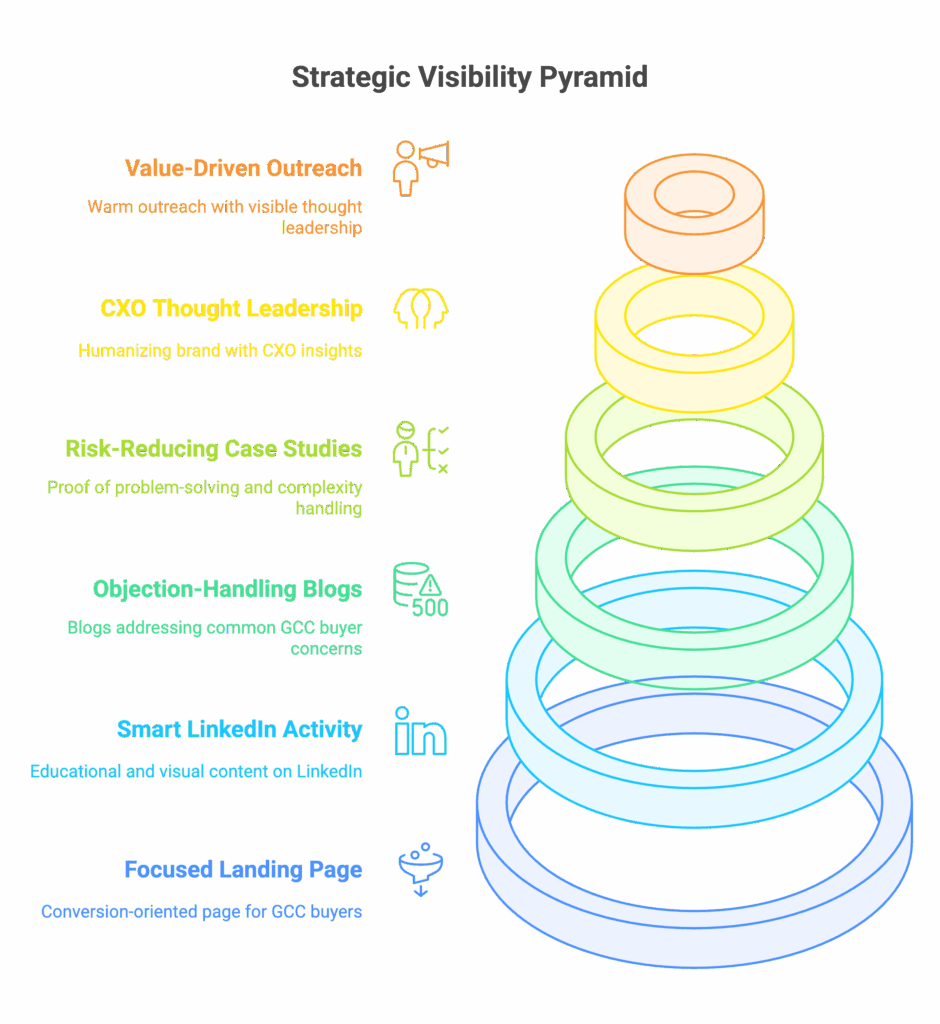
Simply “posting more” or “updating the website” is not strategic visibility. It needs to be layered, and built to serve enterprise buying behaviours.
Here’s what it includes:
1. A Focused Landing Page
A dedicated, conversion-oriented page that explains your capabilities, domain focus, and differentiators – specifically tuned to GCC buyers.
2. Smart LinkedIn Activity
Decision-makers across functions, from operations to procurement, spend time on LinkedIn. Your brand needs to show up through:
- Educational carousels
- Short, visual explainers
- Technical POVs
- Leadership-driven opinion pieces
These also help you increase algorithmic visibility and signal that you are active and engaged with what matters.
3. Blogs That Handle Objections
Most GCC deals involve long nurturing cycles. During that time, your content must work for your pre-sales teams. Well-structured blogs can:
- Help early-stage influencers convince internal stakeholders
- Show that you understand the complexity of enterprise needs
- Handle objections like “Are they too small?” or “Do they understand compliance?”
4. Case Studies That Reduce Perceived Risk
Enterprise buyers don’t want to be your first big client. They want evidence.
Case studies provide proof. Not just of what you did, but of how you think, what problems you solve, and how you handle complexity.
A well-written case study can tip the scale in your favour when buyers are comparing vendors with similar capabilities.
5. CXO-Led Thought Leadership
In B2B, people buy from people. GCC leaders want to know the minds behind the company.
Regular status updates from your CXOs humanize your brand. They demonstrate insight and alignment with global business values.
6. Warm Outreach With Value-Driven Messaging
To make your cold pitches and messages warmer, you need to build a digital context with the help of blogs, social posts, and proof points. Smart LinkedIn outreach or a well-planned email sequence that builds on visible thought leadership performs better.
The Bottom Line
This isn’t about flashy campaigns or paid ads. It’s about strategic, layered digital visibility built around how real enterprise buyers behave. If you are targeting GCCs, the most important asset you can build right now is trustand that begins with being seen, understood, and remembered before your competitor.
At Midas Touch, we specialize in helping B2B technology companies make a meaningful digital impact, especially when engaging with enterprise audiences like GCCs.
With over 15 years of experience in complex sales cycles, IT services, and stakeholder-centric communication, we’ve helped 250+ firms go from being invisible to becoming influential. Our strength lies in understanding what your buyers actually care about and creating the kind of digital presence that earns their attention and trust.
We know how to make the right people notice you. Let’s connect if it is important for you.

