

The Harsh Reality CEOs Are Facing Today
If you are the CEO or revenue leader of a mid-sized B2B technology company, chances are your growth playbook hasn’t changed much in the last decade. You’ve probably always depended on:
- Referrals and networks to open doors
- Past project successes to win credibility and references
- Account mining to deepen relationships
- A capable sales team to “make the numbers”
These tactics worked well in the B2B environment – until they didn’t.
Today, many CEOs find themselves frustrated by stalled pipelines, pricing pressure, and longer buying cycles.
It’s not your team’s fault. It’s not even your solution’s fault. The truth is this:
The B2B growth challenges you’re facing can no longer be solved with yesterday’s playbook. Unless you invest in strategic digital brand building, sustainable revenue growth will remain elusive.
What’s Changed in the B2B Landscape?
1. Competition Has Exploded
The B2B technology solutions space now resembles the consumer goods market. It’s crowded, noisy, and commoditized.
- Skills and past successes are no longer differentiators; they’re just table stakes.
- New pricing models emerge daily, driving margins down.
- Contracts are shorter, renewals harder.
- Even breakthrough solutions struggle to get attention.
This is why digital brand building for B2B is no longer optional. Your brand must cut through the noise before sales can even begin.
2. The New B2B Buying Cycle
Once upon a time, the B2B buying cycle was predictable: discovery, consideration, decision. Your sales team could engage with tech users or business decision makers early in the cycle and make a case.
Not anymore. The new B2B buying cycle is incredibly unforgiving:
- 78% of buyers evaluate only 3 vendors.
- 71% select the first vendor they engage with.
- If you’re invisible in the discovery phase, you’re not late — you’re out.
This is the reality of B2B revenue growth strategies today: sales teams only succeed if marketing ensures your brand makes the shortlist.
3. Enterprise Buying Behaviour Has Shifted
Another major B2B growth challenge is the prevalence of buying committees:
- In companies with 100–500 employees, an average of 7 people now participate in purchase decisions.
- In larger enterprises, the number jumps to 13+ decision-makers (Forrester).
- 75% of B2B purchase decisions now take longer than in 2023.
Perhaps most challengingly for mid-sized companies, the other members of the buying committee (read process, procurement, IT, etc.) are not impressed by technical capabilities or product features. They are primarily motivated by FOMU (Fear Of Messing Up). They would rather not take a call than pick a side that could later go wrong.
This makes selling harder because:
- Referrals and personal networks are no longer enough.
- POCs don’t convert into purchase orders.
- The “usual suspects” keep winning RFPs.
- Early adopters become harder to find.
The most common decision has become “no decision” because everyone in the committee can’t agree to proceed with a vendor.
This is why CEOs must rethink their B2B sales and marketing alignment strategy — brand visibility must influence not just one champion but convince and reassure the entire B2B buyer committee.
4. Trust is the New Currency
According to Dentsu’s research across 14,000 B2B buyers:
The #1 factor influencing buying decisions is “feeling safe while signing the contract.”
Yet:
- 80–90% of B2B buyers already have a vendor shortlist before they even start research (Bain).
- 95% of buyers are not actively in buying mode, and when they are, they pick the most familiar vendor.
- 68% of buyers say vendors all sound alike.
This trust gap is why brand trust in B2B sales has become non-negotiable. Buyers don’t just want a solution. They want reassurance that they’re making a safe choice.
Why Digital Brand Building is an Absolute MUST!
This is the crux of modern B2B technology company marketing:
Brand strength is no longer a “nice-to-have.” It is the force multiplier that makes every sales effort more effective.
Think of it like this:
- Your sales team closes the doors they can access.
- Your brand ensures those doors open in the first place.
Without strategic brand building, your growth relies on chance, not strategy.
The AI Disruption: Search Will Never Be the Same
Many CEOs still believe SEO is their safety net. But AI in B2B marketing is rewriting the rules:
- 90% of B2B buyers use GenAI during the B2B buying cycle.
- AI-driven search provides answers, not just ranked pages.
- Over 90% of citations in AI-curated answers come from earned media, not ads.
This has huge implications for the future of B2B SEO:
- Keyword-driven strategies alone won’t cut it.
- Content must showcase authority, thought leadership, and trust.
- You need to “own” content clusters and answer buyer questions at scale.
- If you thought big ad budgets would drive scale, it’s time to think again!
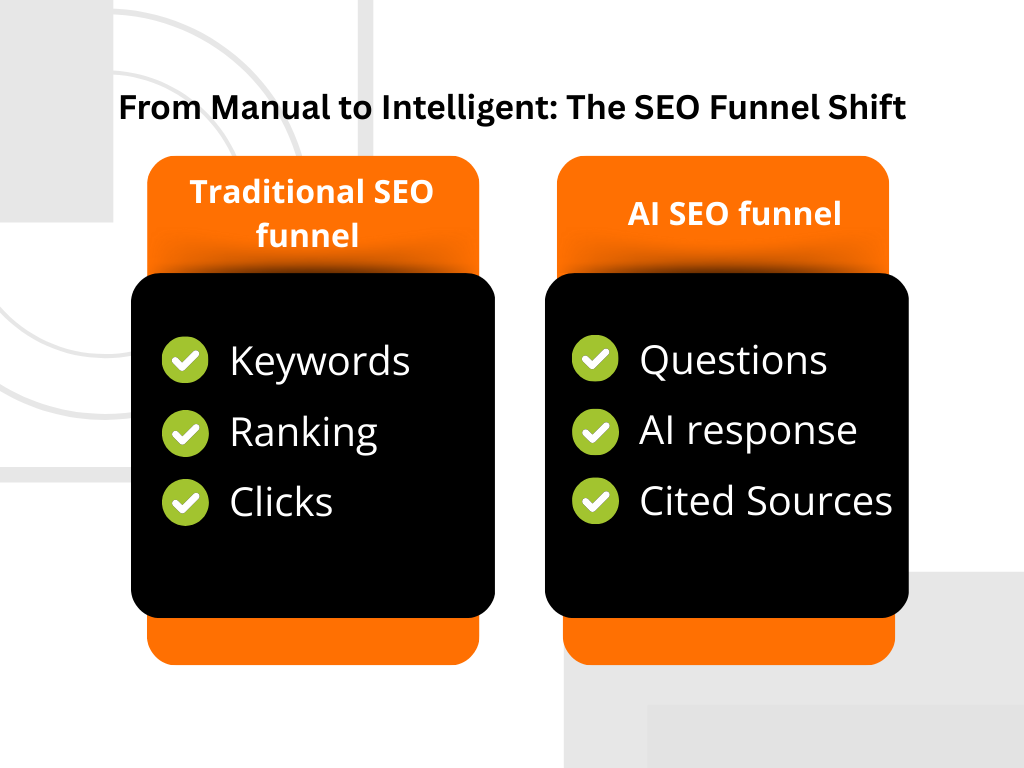
In other words: AI and B2B marketing now demand that your brand be everywhere buyers seek validation — not just on Google’s first page.
Why Current Marketing Approaches Fail CEOs
Most mid-sized firms still rely on fragmented, tactical efforts:
- Social media managed in isolation
- SEO campaigns with no strategic narrative woven through them
- Inward-facing content with no resonance and vision
- Marketing is siloed away from sales goals
This piecemeal approach explains why digital marketing for mid-sized B2B companies often feels like “spend more, get less.”
As a CEO, you need more than execution. You need B2B brand visibility strategies tied directly to growth.
What CEOs Must Do Differently
Here’s the new playbook for B2B revenue growth strategies:
- Be Visible Early: Use thought leadership, content clusters, and earned media so your brand is part of the 3 vendors buyers evaluate.
- Build Trust at Scale: Invest in storytelling, case studies, testimonials, and differentiated messaging that influence hidden buyers.
- Adapt to AI Search: Focus on authority-led content that answers real buyer questions — not keyword stuffing.
- Break Down Silos: Ensure B2B sales and marketing alignment — with shared goals, metrics, and visibility.
- Demand More from Agencies: Don’t settle for fragmented services. Look for strategic partners who understand digital brand building for B2B and act as part of your leadership team.
A CEO’s Checklist for Growth in 2025
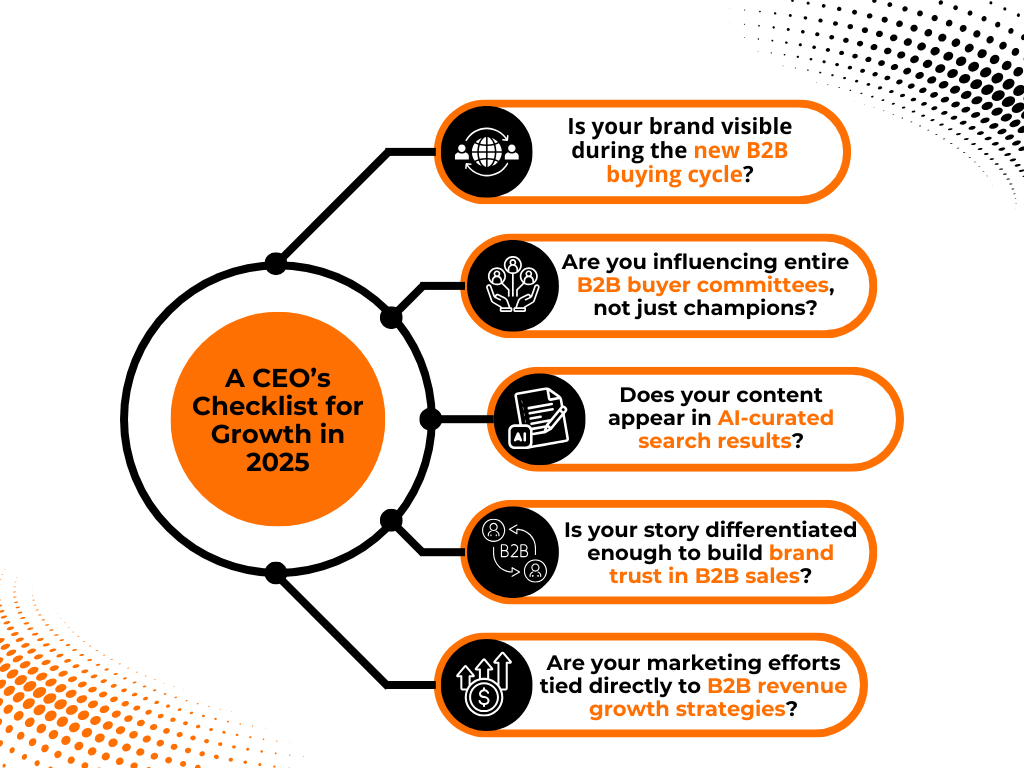
If your answer to any of these is “No” your growth is at risk.
Final Word: Growth Without Brand is a Mirage
The future of B2B SEO, digital brand building, and buyer trust is already here. CEOs who continue relying solely on referrals, RFPs, and account mining will struggle against competitors who are already investing in digital marketing for mid-sized B2B companies.
The reality is simple:
Brand marketing is the cost centre that multiplies your sales effectiveness.
Your competitors are already moving in this direction. The winners of 2025 and beyond will be those who don’t just sell solutions. They will build brands that buyers trust before the first sales call.
The question isn’t whether you can afford to invest in B2B brand visibility strategies. The real question is: Can you afford not to?
